Revising a Cryptozoology Book

On May 4, 2013, in philosophy, Sighting in Papua New Guinea, by Jonathan Whitcomb

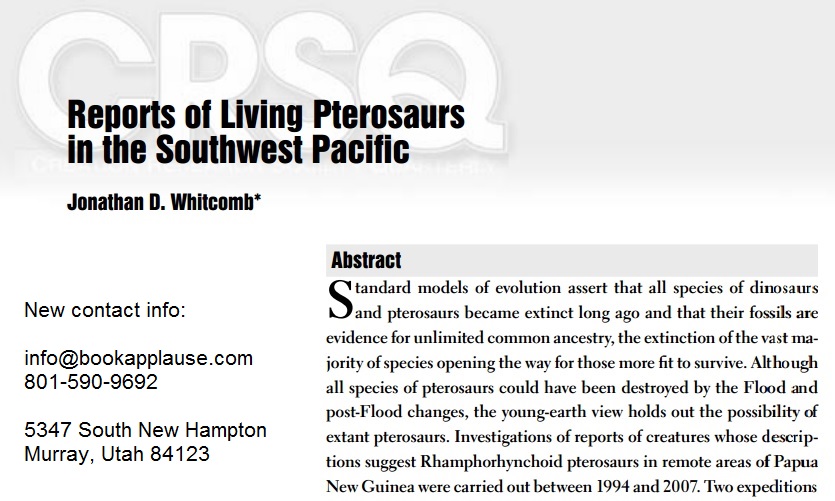
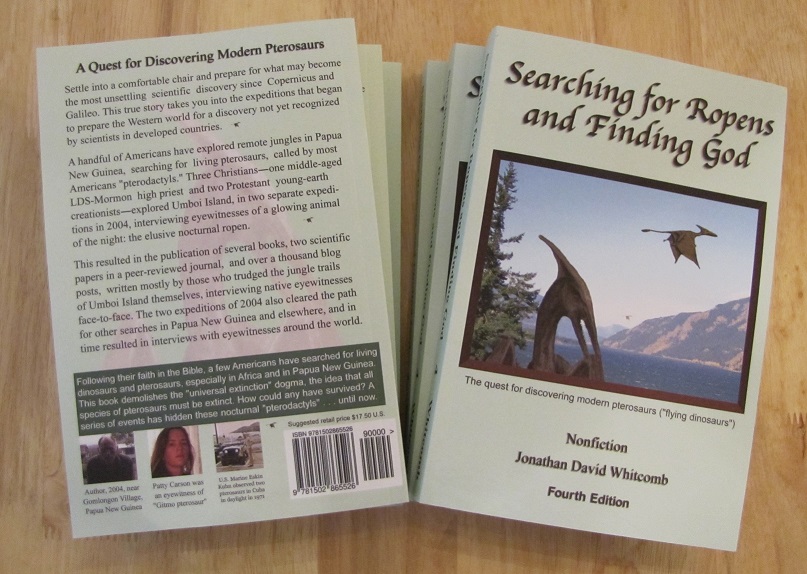
I’m revising my first book, Searching for Ropens, and expect it will be published before Christmas. The third edition will differ from the second in two significant ways:

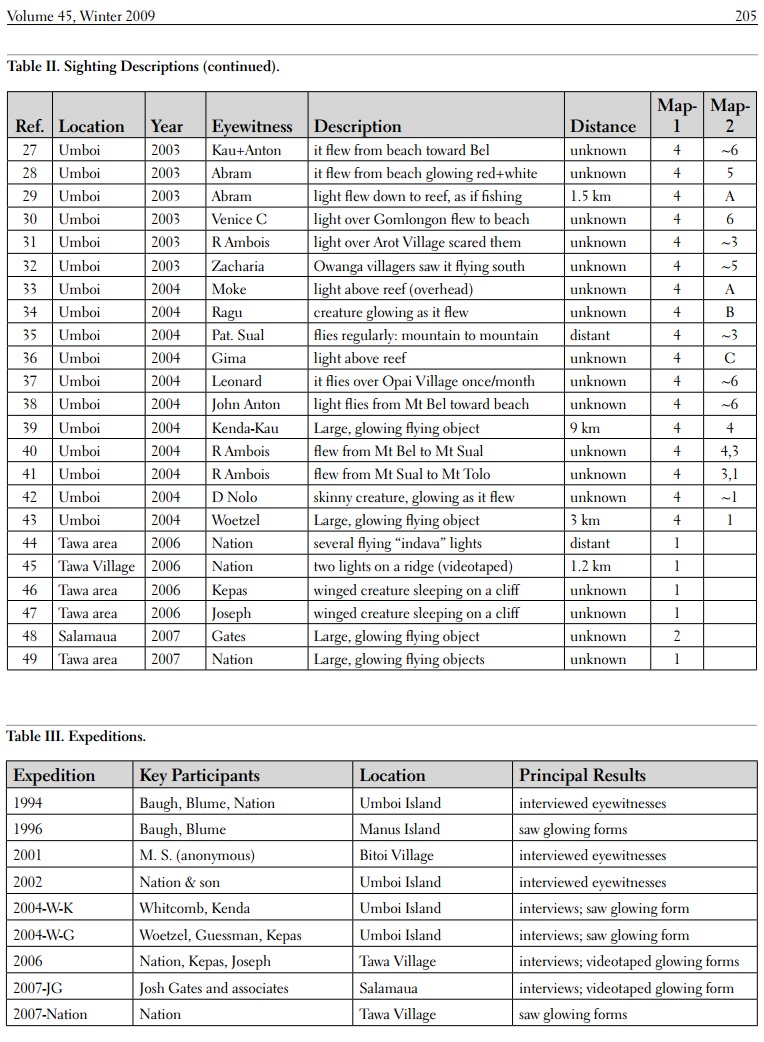
  1. It will have new pterosaur sighting reports and insights, and more about the explorers themselves, including Garth Guessman, David Woetzel, and Paul Nation (and, of course, me: Jonathan Whitcomb). It will also have more details about other expeditions: Destination Truth and the Monsterquest-episode expedition with Guessman.
  2. The genre will still be a mixture of spiritual-religious and cryptozoology-adventure, in that order, but this will be made clear in the promotions; I have no desire to offend any cryptozoologist who would dislike reading about religious beliefs.

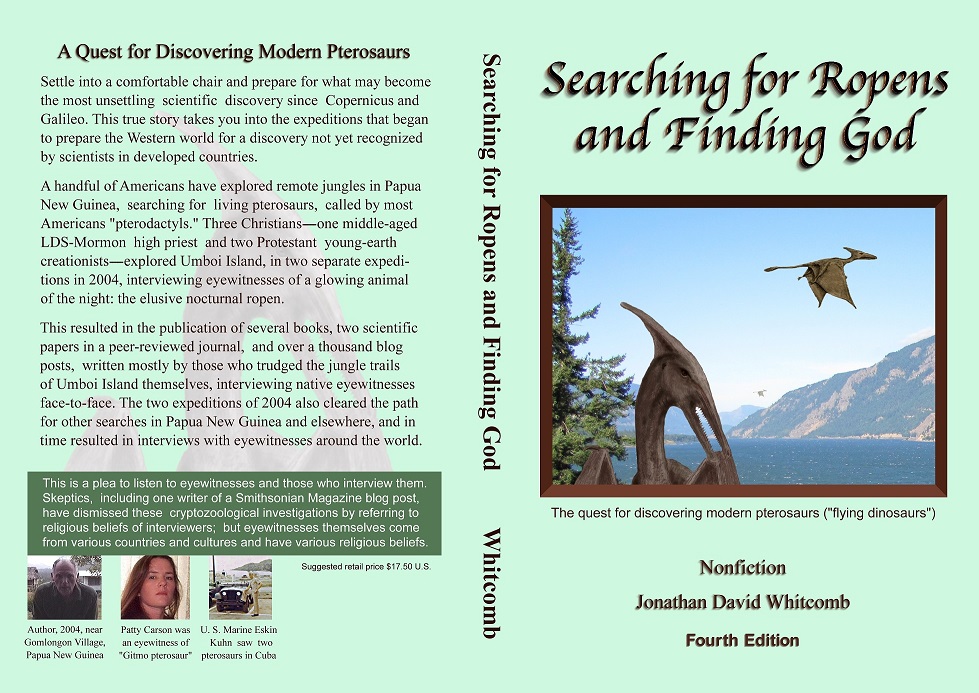
The title will also be revised: Searching for Ropens and Finding God.

Anything I would quote from the new edition may be revised before publication, so I now quote from the second edition:

Acknowledgements (previous edition)

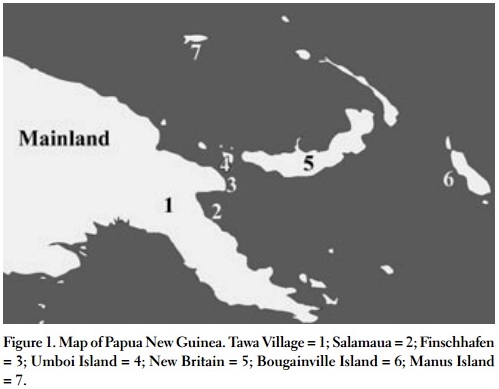
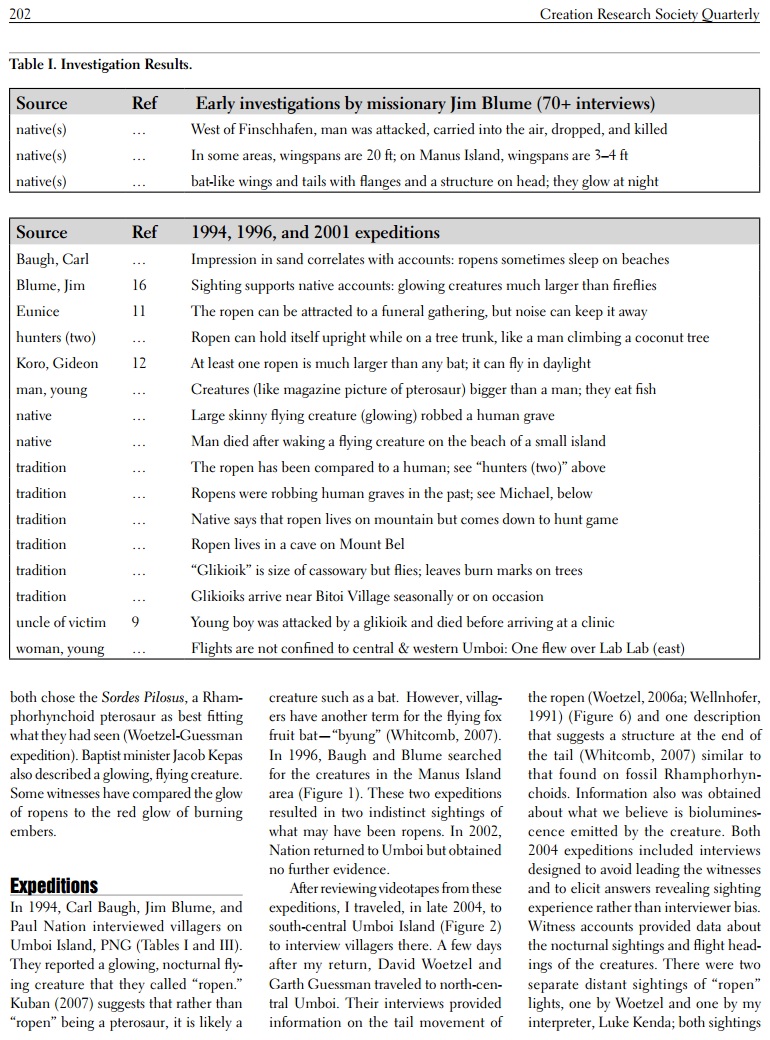
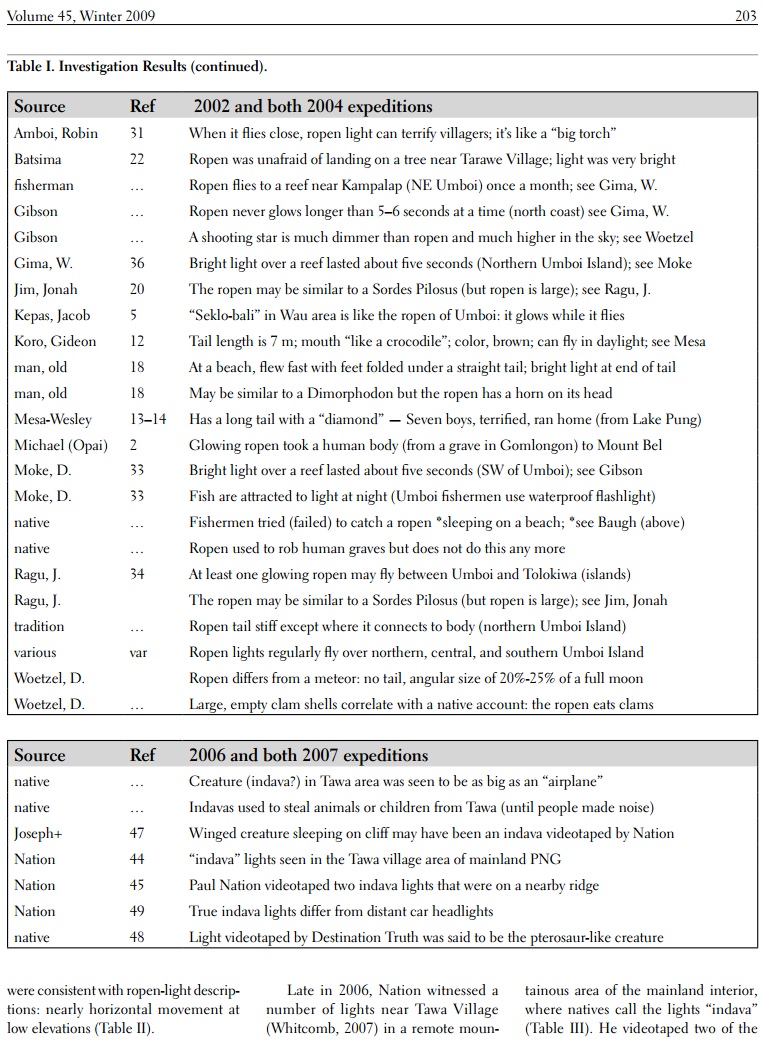
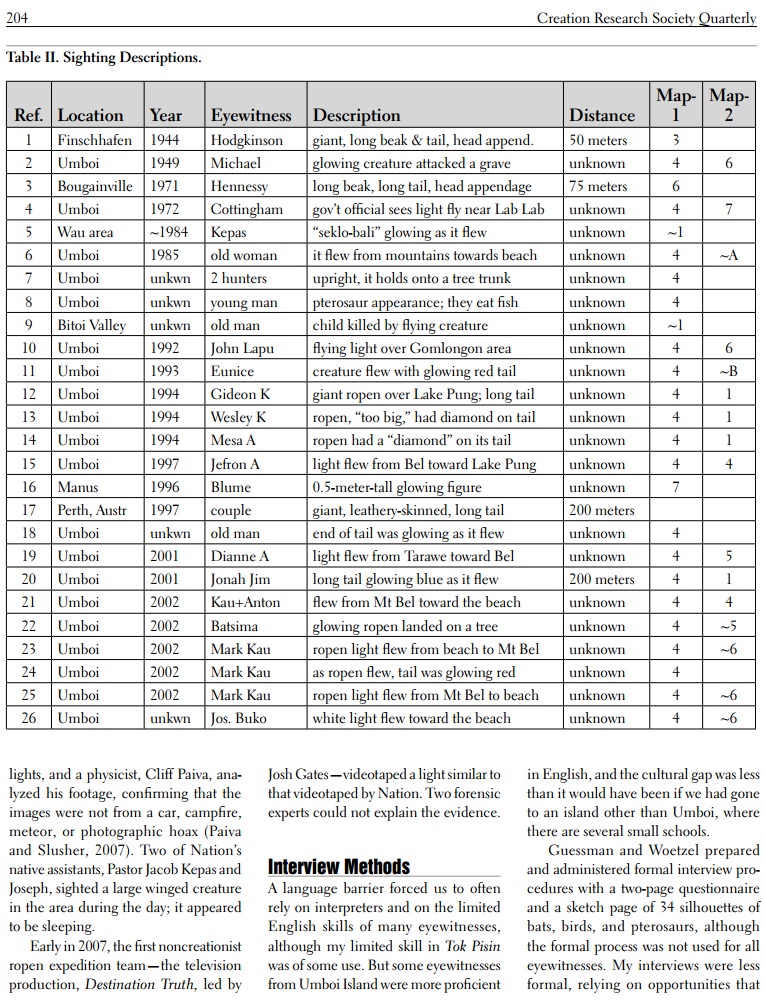
A key to successfully exploring a sparsely populated wilderness is, ironically, people-skills. My father and mother inspired others, lifting self-esteem; following their examples, I’ve tried inspiring others, though I’ve usually been the one encouraged or inspired. In particular, the pioneering investigations of Jim Blume, Carl Baugh, and Paul Nation illuminated the path for my own investigation in Papua New Guinea; the 2004 follow-through of Garth Guessman, David Woetzel, and Jacob Kepas filled in the gaps of previous expeditions, amplifying and supplementing the successes of those of us preceding them; the generosity of Alex Aguila made possible the 2006 expedition of Paul Nation, whose exploring of a remote area verified the location of many of the creatures (and he brought back the first visual images to the United States; the veracity of the images and testimonies were proven through the work of two physicists: Clifford Paiva and Harold Slusher); the eyewitness testimonies of natives, Australians, and an American veteran, contributed priceless evidence; the love of my wife and three daughters strengthened me to leave the comforts of home; the prayers of family, friends, and other Americans were answered when I found Luke Kenda, who became my interpreter, bodyguard, and counselor. By the grace of the Father of us all, Luke and I were welcomed like brothers by those we met on Umboi Island, and by accepting the friendship of humble Christians in remote villages, we were sheltered, fed, and led to those who made this book possible: the eyewitnesses. Thank you; tenku tru.

.

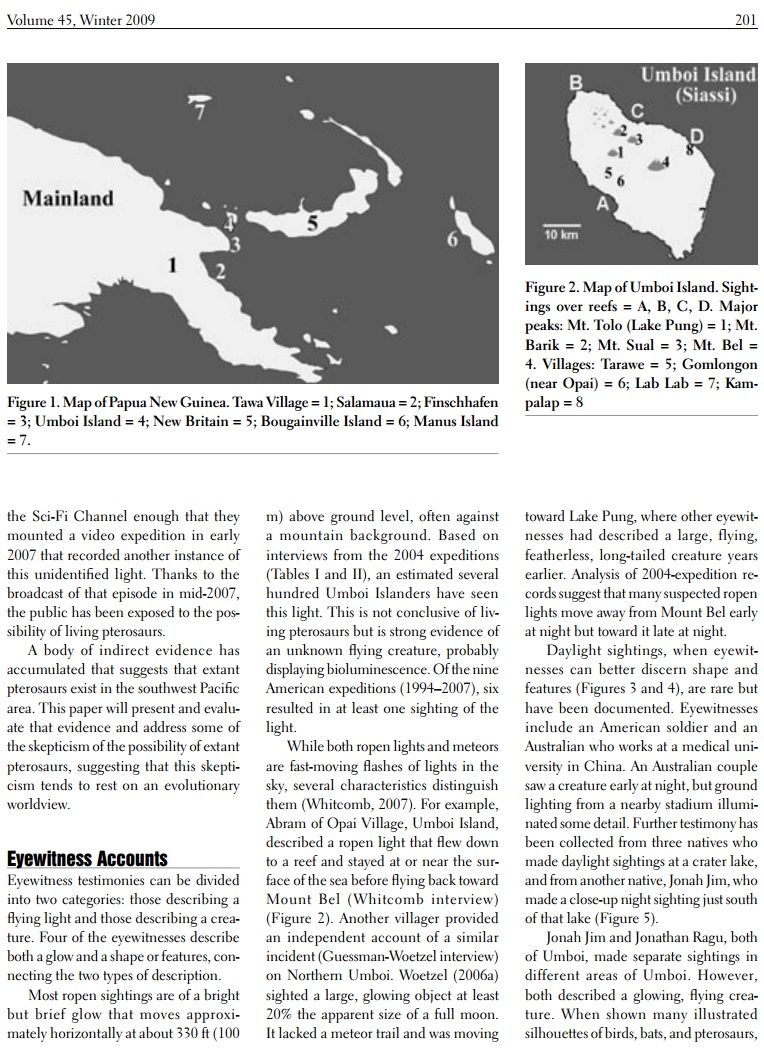
Looking down on Lake Pung, Umboi Island, Papua New Guinea, where the ropen (pterosaur) had flown in daylight around 1994

Lake Pung, Umboi Island, Papua New Guinea (where seven native boys had seen the giant ropen around 1994) - photo courtesy of Garth Guessman, one of those on the second expedition of 2004

###

Pterosaur Extinction (or not)

In Searching for Ropens, I wrote, “Since no researcher in Europe [when fossils were first being discovered] had any knowledge of living creatures similar to the fossils, it was assumed that they were all extinct. The key word is ‘assumed.’. . if only 1% of the  population of Western Europe, in the late 18th Century, had . . .  [seen] living pterosaurs, the universal-pterosaur-extinction notion would never have gotten started.”

Cryptozoology Book

Eskin Kuhn was a U.S. Marine, in 1971, when he witnessed two large pterosaurs flying over the navy base at Guantanamo Bay, Cuba. He has maintained his testimony for decades: He saw, in clear daylight, two featherless long-tailed flying creatures with very prominent head crests.

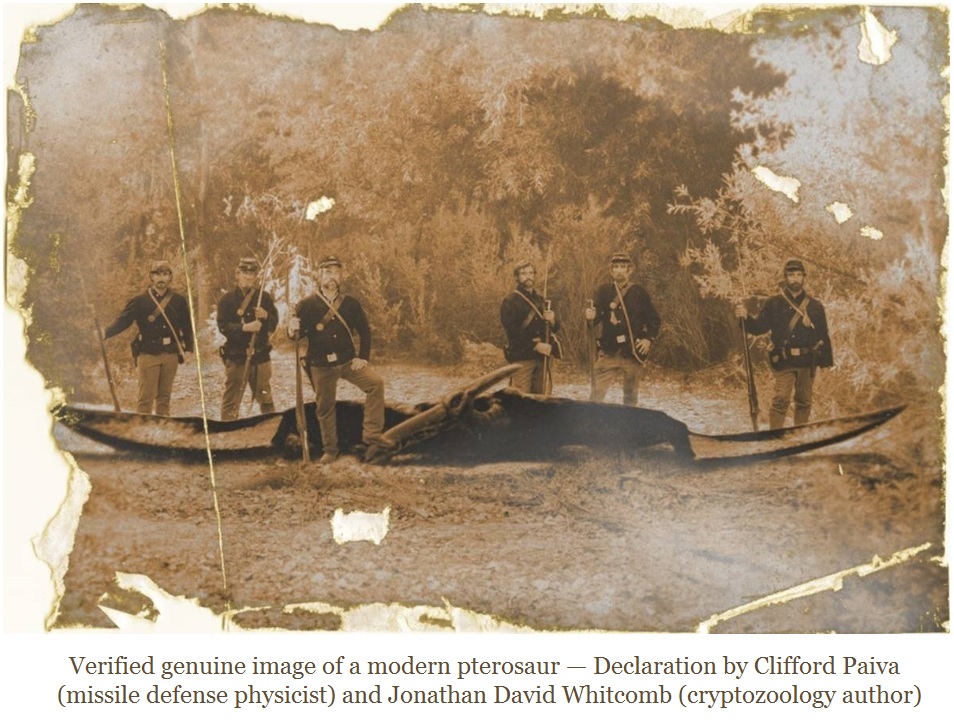
Civil War Soldiers and a Monster Photo

To begin, I do not present Photo #1 as overwhelming evidence for the existence of a huge modern living pterosaur that has a head suggesting a Pteranodon; I interview eyewitnesses, and some of them report sighting details that have convinced me that huge pterosaurs (rare and nocturnal as they may be) live in this modern world of ours.

Tagged with:
 

Cryptozoology Book by Michael Newton

On April 29, 2013, in Uncategorized, by Jonathan Whitcomb

Of the many nonfiction cryptozoology books written by Michael Newton, one stands out: Encyclopedia of Cryptozoology—A Global Guide to Hidden Animals and Their Pursuers. Of the many hundreds of cryptids mentioned, two jump out for us: ropen and kongamato.

.

cryptopzoology book - nonfiction - by Michael Newton - published early in 2005

Encyclopedia of Cryptozoology by Newton

We would not expect a large reference book on cryptozoology to contain information about two expeditions late in 2004, when the book was published early in January, 2005. That is not the case here; in fact, so much has been learned about the bioluminescent flying creatures of Papua New Guinea, in more recent years, that much of Newton’s book is outdated in its entry “ropen.” For now, let’s look at what this encyclopedia says about the kongamato.

Flying Cryptid in Africa: Kongamato

The Encyclopedia of Cryptozoology has a major entry for the kongamato of Africa. It mentions Frank Melland, whose memoirs (published in 1923) include reports of a flying creature in what was then Northern Rhodesia.

. . . ‘a lizard with membranous wings like a bat.’ . . . Kongamato’s ‘wing-spread was from four to seven feet across . . . the general color was red. It was believed to have no feathers but only skin . . . [and] to have teeth in its beak . . .’

When Melland displayed a drawing of a pterosaur, ‘every native present immediately and unhesitatingly picked it out and identified it as a kongamato.’

Newton’s book also mentions G. Ward Price, who interviewed an eyewitness of a kongamato in 1925. The native had been attacked by one of the creatures and when shown a picture of a pterosaur, “screamed in fright.” It seems the kongamato at least resembles a pterosaur, if it’s not actually a modern species of that flying creature.

###

.

Michael Newton’s Encyclopedia of Cryptozoology

[Answering some statements in Newton's book] Some species of animals continue to grow as they mature, differing from common species of birds which have a particular maximum size; it seems that the ropen is one of those that keeps growing with age. Regarding the “Duah,” there is probably no such name, in Papua New Guinea, for any flying animal; the proper name is “duwas.”

Cryptozoology Book on Live Pterosaurs [not the book mentioned above]

“He has focused on the accounts of witnesses who saw something, and that adds credibility. The writing is easy to read and he adds comments and analysis to make it all more useful. Mostly, the author lets the sightings speak for themselves, which is good. A worthwhile book.” [Amazon review of the first edition of Live Pterosaurs in America - It is now in its third edition]

Pterosaur Sighting Reports

I live in Lamero, Kentucky. Its a small, rural area located along the Daniel Boone National Forest. . . . a lot of caves . . . seriously like swiss cheese . . . [In July of 2012] It was just a little after sunset . . . we were outside, sitting on his deck . . . I was looking northward when Brandon, my friend, shouted . . . Approaching us from the east . . . were two very large animals. . . . They appeared to be a brownish color and had every characteristic of a pterodactyl, from head to tail. I’d say they were roughly 15+ feet long and were flying at least 40 mph . . . [pterosaur sighting reported to Jonathan Whitcomb]

Pterosaur Sightings – not Extinct

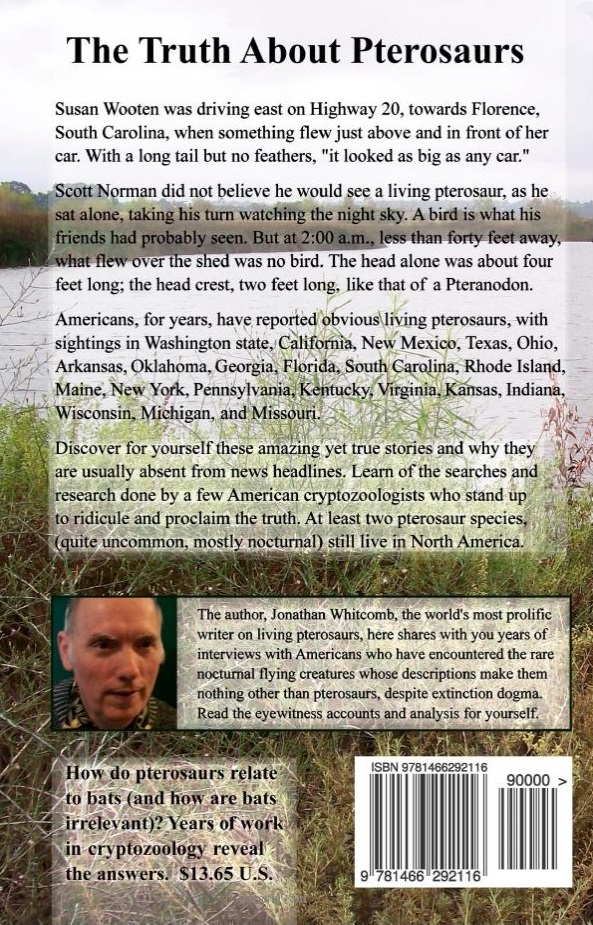
He was interviewed by Jonathan Whitcomb, who found the man’s testimony credible, even though the sighting was extraordinary: The length of the pterosaur-like flying creature, from end of tail to beak, was about the width of Campus Drive, about thirty feet . . .

###

.

book cover "Live Pterosaurs in America" - third edition in cryptozoology nonfiction genre

Cryptozoology book: Live Pterosaurs in America (3rd edition) by Whitcomb

From the Title Page of Live Pterosaurs in America (third edition):

How are sightings in the United States related to those in the southwest Pacific? How do some apparent nocturnal pterosaurs pertain to bats, and how are bats irrelevant? How could modern living pterosaurs have escaped scientific notice? These mysteries have slept in the dark, beyond the knowledge of almost all Americans, even beyond our wildest dreams (although the reality of some pterosaurs is a living nightmare to some bats). These mysteries have slept . . . until now.

.

Tagged with:
 

More Religion than Investigation?

On April 15, 2013, in philosophy, by Jonathan Whitcomb

Book Review on Amazon

On April 12, 2013, a skeptic of pterosaur sightings posted a brief review on Amazon, dismissing my recently published book Live Pterosaurs in Australia and in Papua New Guinea. At first, the review appeared to me a mistake or a dishonest attack, for my book examines many sightings of apparent pterosaurs and emphasizes four critical encounters, four pillars of cryptozoological credibility in my opinion, not just “two” reports; I thought perhaps ”WS” referred to a different book, not mine. After looking more closely, I noticed the adjective “intriguing:” The critic wrote, “The book really consists of one or two intriguing reports.” But the other adjective, “really,” can mislead people into thinking my book examines no more than two eyewitness sightings, which is far from the truth.

negative book review on "Live Pterosaurs in Australia and in Papua New Guinea" - published on Amazon on April 12, 2013

Perhaps WS gave my book two stars instead of one because the reviewer found one or two of the reports intriguing; WS doesn’t say. But I’ll address some of the criticisms.

I was also struck by the title of the book review, “more religion than investigation,” for I had carefully avoided including any preaching while writing Live Pterosaurs in Australia and in Papua New Guinea (LPAPNG). This is a cryptozoology book that exhorts open-minded examination of eyewitness evidence, nothing like a book on religion. Part of one page refers to the non-religious accomplishments of a few Biblical creationist explorers, their interviews with natives in Papua New Guinea, but that hardly changes the genre of the book: “cryptozoology.”

False “Racism” Statement

I have done a word scanning of this book. The words completely absent include:

  • racism
  • race
  • aboriginal

Nobody will find any of those words in the book, for they’re absent.

The reviewer wrote the following:

He describes science . . . and even equates it with racism . . .

At first, the comment on racism lead me to suspect the person writing this review had not read my book but some other publication instead, or had read more than one author and had become confused. Never in my life have I written anything that even hinted at the idea that science “equates” “with racism.” I then scanned the book for the word “native” and found nothing supporting the critic’s words, but I found two statements almost relevant:

The natives were not trying to deceive us into believing in a fictional creature, contrary to what some American critics later proclaimed. [from the chapter "Another Expedition on Umboi Island"]

Was WS thinking that accusing natives of dishonesty is racism? I can see that possibility. But why would the critic believe that “some American critics” equates with “science?”

WS says that I complain “that scientists no longer believe in human honesty.” Where did I say that? Searching again in the book, scanning it for “lie,” (equivalent to “deceive” and related to “honesty”), I found the following in the first chapter:

On that point, I have found many rejections of eyewitness testimonies to be far from objective and far from mild-mannered. One skeptic, a non-scientist, built a whole web site to ridicule the concept of modern dinosaurs and pterosaurs, putting the words “stupid” and “lies” into the URL address of the site. [from the first chapter, "How can pterosaurs be alive?"]

Did WS overlook “non” and equate “non-scientist” with “science?” Many readers, including myself, have made that kind of reading mistake, especially when we are expecting a particular point of view in what we’re reading. Was the critic simply careless in reading only portions of the book? WS gives no material explanation and gives no example for his conclusions. Why? The more merciful explanation that I see is that WS was careless; I will not assume the worst.

My Conclusion

I sometimes write about pterosaurs and religion, but this book, Live Pterosaurs in Australia and in Papua New Guinea, has almost no religious content at all except for a few sentences about expeditions of creationist cryptozoologists who interviewed native eyewitnesses in Papua New Guinea. This is a cryptozoology book, notwithstanding WS makes no mention of that fact.

I think I know what WS meant when, in the middle of the brief review, that critic wrote, “Maybe someone will give this subject a serious treatment at some point, but this isn’t it.” I suspect WS means that the book is not a “serious treatment” and perhaps the “subject” was  eyewitness accounts of apparent pterosaurs. The critic gives no details or explanation. I respond, “Maybe someone will write a more precise review, based on the actual contents of the book, but this review isn’t it.”

###


nonfiction cryptozoology book in electronic format - living pterosaurs

Live Pterosaurs in Australia and in Papua New Guinea

Preface

You will here find reports of encounters with apparent living pterosaurs, including many accounts never before published in any book. Other sighting reports are condensed from the print book “Searching for Ropens.” The ebook you are now examining is neither exhaustive nor rudimentary, but it explains most of what most Australians, and others, need to know about what might, on rare occasions, fly over their heads at night.

I believe in living pterosaurs and hope they will soon be officially discovered. More important, I believe in you, that you can soar above dogmatic assumptions about extinctions. I hope that you already understand that we are more than a by-product of culture: Our existence transcends the boundaries of the human cultural assumptions that have shaped our beliefs.

Now is the time for us to listen carefully, to think clearly, and to act accordingly rather than simply react when a cultural belief is contradicted: now, not after the official scientific discovery of modern living pterosaurs.

.

Addendum:

After WS communicated with me about our differing points of view, he agreed to change the title of his review to “More scientific approach would have been more effective.” More recently, I noticed that I had neglected to include the word “cryptozoology” in the Amazon “Book Description.” I have now submitted additional words to make the genre clear. (I’m as human as anyone else.)

Readers have come forward, soon after the publication of this negative review, offering support for my book. A notable comment comes from the prolific author Michael Newton, who wrote one of the most respected nonfiction books of cryptozoology ever published, Encyclopedia of Cryptozoology: A Global Guide to Hidden Animals and Their Pursuers. Here is what he says about my newest book:

“Jonathan Whitcomb’s Live Pterosaurs in Australia and in Papua New Guinea adds important new information to his previous works on this subject. Disputes over theology aside, ‘young earth’ creationists remain the primary dedicated field researchers pursuing reports of these most intriguing cryptids.”

Michael Newton Author of 78 nonfiction books, including many on cryptozoology

www.michaelnewton.homestead.com

.

Tagged with:
 

Live Pterosaurs in Australia, E-Book

On October 15, 2012, in Sighting in Papua New Guinea, by Jonathan Whitcomb

My newest nonfiction cryptozoology book, Live Pterosaurs in Australia and in Papua New Guinea, is published only in e-book format (for the Amazon Kindle and other compatible devices). Amazon estimates it is about 76 pages long, which is shorter than my first two books about modern living pterosaurs.

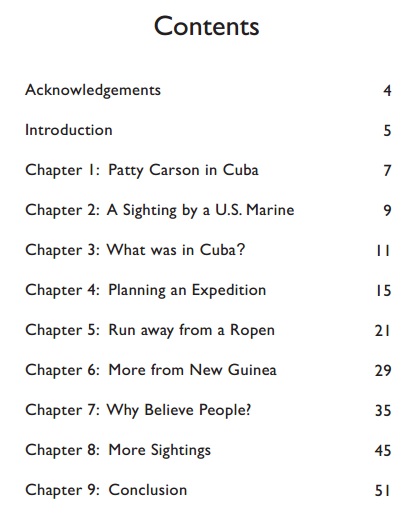
Table of Contents for "Live Pterosaurs in Australia and in Papua New Guinea"

Screen shot of the Table of Contents (above)

Preface (first paragraph)

You will here find reports of encounters with apparent living pterosaurs, including many accounts never before published in any book. Other sighting reports are condensed from the print book “Searching for Ropens.” The ebook you are now examining is neither exhaustive nor rudimentary, but it explains most of what most Australians, and others, need to know about what might, on rare occasions, fly over their heads at night.

Dedication

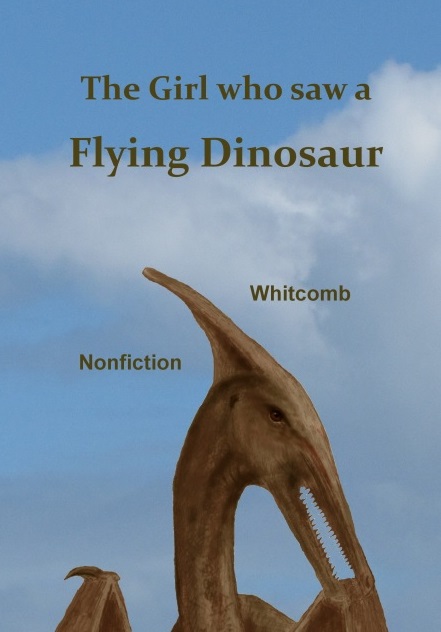
To the eyewitnesses who have reported their sightings of apparent pterosaurs, including two artists, Patty Carson and Eskin Kuhn, who encountered, at Guantanamo Bay, Cuba, in 1965 and 1971, the pterosaurs shown on the cover of this book, and to the explorers and researchers and journalists who carry eyewitness reports out of the shadows and into the light of public knowledge—thank you.

Chapter One – “How can Pterosaurs be Alive?”

I have no desire to shock anybody. I partially agree with the general concept of extinctions, but without committing myself to any time frame. Most species of dinosaurs and pterosaurs appear to have been extinct for some time; nevertheless, after many years of investigations, my associates and I assert that at least two species of pterosaurs live in the southwest Pacific. Indeed, similar ones live in other areas of the world as well.

screen shot of part of a page from the book "Live Pterosaurs in Australia . . ."

Screen shot: near the beginning of Chapter One

Live Pterosaurs in Australia and in Papua New Guinea

Some Americans and Australians hesitate to report their shocking sightings of flying creatures that appear like what should not exist. That’s the way things are. We may understand something of what they feel. . . .

Pterosaurs in Australia – Book Nearly Complete

I believe in living pterosaurs and hope they will soon be officially discovered. More important, I believe in you, that you can soar above dogmatic assumptions. I hope that you already understand that we are more than a by-product of culture: Our existence transcends the boundaries of the human cultural assumptions that have shaped our beliefs. [quoting the title page of the book]

nonfiction cryptozoology book in electronic format - living pterosaurs

Tagged with:
 

Last week, a British reader (CJ) wrote a lengthy blog post about the third edition of my cryptozoology book Live Pterosaurs in America. Only a small portion of his post refers to Biblical Creationists, but it still seems appropriate to quote parts of his book review here.

Comment:

“I want to believe in big flying dinosaurs roaming the skies, but experience and common sense argue against it. So far I have never been chased by one as I wander through town.”

Response: I too have, at times, felt it strange, as I take a walk around my neighborhood, as I ponder the possibility that a modern pterosaur might at any time fly over my head. I too have never seen anything like a pterosaur. But nine years of investigating eyewitness sightings brings my mind back to the more convincing accounts, and I realize that I have just been less lucky than the eyewitnesses. These wonderful flying creatures, although nocturnal, are quite real, in spite of Western extinction indoctrination.

Comment:

“I get the impression [from reading this book] it is rather competitive, and political, and perhaps as backstabbing as any other part of cryptozoology seems to be — but then again maybe not. You see Whitcomb, and the majority of the researchers are Creationists, and not shy about proclaiming the fact.”

Response: I have found some skeptics who have ridiculed my associates and me, for our beliefs and proclamations regarding sightings of apparent pterosaurs; I had not thought of that as “backstabbing” but it may be what CJ refers to. It seems more like strangers throwing rotten tomatoes at our faces.

“Creationist” is not such a precise label as people might think. For example, I firmly believe in many literal factors in the Old Testament, including the existence of Adam and Eve as real humans, the first people on this planet; I do not believe, however, that the “beginning” referred to in the beginning of Genesis refers to the creation of the universe. I am not a “young universe” creationist, but I am a “young earth life” creationist.

Comment:

“So here I am, a very convinced “Evolutionist” who has written a great deal on Darwin, Chambers, Russel Wallace etc reading a  book on Live Pterosaur sightings by an out loud and proud Creationist.  And you know what? It really makes no difference to the case. So Whitcomb believes in living pterosaurs? The sceptics who attack his research are equally convinced they are extinct. It’s an issue it is rather hard to maintain a strict impartiality on. To be honest, I have no problem with people holding strong beliefs on any issue, so long as they are aware of them and their potential biases, and so long as they declare them openly.”

Response: That sounds reasonable to me. I admire CJ’s open-mindedness in examining the case for modern living pterosaurs. My cryptozoology book Live Pterosaurs in America is not meant to convert the masses to Biblical creationist ideas, although the overall purposes of my writings include opening closed minds to critical truths in the Bible. Part of its purpose is to show that modern living pterosaurs are not confined in remote tropical rain forests in Papua New Guinea or in Africa, for they live (and sometimes appear to humans) in the United States of America.

To read CJ’s long blog post, see: A Whole New Level of Weirdness: Book Review of “Live Pterosaurs In America” (3rd Edition)


book cover "Live Pterosaurs in America" - third edition in cryptozoology nonfiction genre

Tagged with:
 

Skepticism or Skip Decision

On February 16, 2012, in Uncategorized, by Jonathan Whitcomb

Why believe in a living pterosaur? Why disbelieve an eyewitness of a living pterosaur? Some who first learn about these investigations assume they are using scientific skepticism when they skip the decision to investigate for themselves. Of course, not everybody can delve into every report that appears to have the eery glow of the paranormal. But skipping the decision to look deeper is not scientific, even when the word “science” is used in repeating a century-plus old indoctrination of a whole society.

Not Everybody Embraces Living Pterosaurs

This species of critic is not satisfied at destroying an idea; they appear anxious to destroy the reputation of anyone who disagrees with them. More than once this kind of critic, on this online forum, has accused me of dishonesty for using something other than my real name, and this when those same critics use fantastic online names that must be made-up. Once, on the same forum of commentators with obviously made-up online names, I was accused of deception for using my real initials instead of my real full name. Really!

From the third edition of the nonfiction book Live Pterosaurs in America

“Since the two ropen expeditions of 2004, in Papua New Guinea, more Americans have learned of the living-pterosaur investigations and the many resulting eyewitness interviews. Many web pages have sprung up, many of them by explorers themselves. But despite other web pages, by scornful critics who never went anywhere and never interviewed anyone, those two expeditions, and those that preceded and followed them, are causing an awakening, opening human minds in the birth of a new perspective: Universal pterosaur extinction has been an assumption; some pterosaur species are still living.”

Why “Stupid?” What “Lies?”

Referring to creationists, in the first sentence Konkus uses the word “idiocy,” and in the second sentence, “idiot.” Starting off like that brings up the concept of bulverism. Also in the second sentence, Konkus gives a straw man argument, rather than quoting any creationist.

cover of nonfiction cryptozoology book "Live Pterosaurs in America"

Third edition of Live Pterosaurs in America (nonfiction/cryptozoology)

From an Amazon review of the second edition of this book:

This is an updated review of the book and I am changing my rating to 5 stars. This book has been on my shelf for almost a year now. I pick it up every now and then and a part of me becomes more impressed by the book every time. . . .  I highly recommend this. You may find yourself almost believing in it, although that is not even the authors intent! Whitcomb painstakingly reviews every account for credibility and reason. This man is not a crank. He tries to weed out would be hoaxes and miss-identification. This is not a guy looking to create evidence to confirm his own beliefs. On top of this, I have great respect for a guy who follows his dreams so passionately. He has traveled to Papua New Guinea to search for the creature there and this book is somewhat of a sequel if you will. After Whitcomb traveled to New Guinea, he started to collect more stories from North America concerning the pterosaur like creature . . .

Whitcomb is a pterosaur expert in the cryptozoological sense, interviewing eyewitnesses of flying creatures whose descriptions make them obvious candidates for a modern-pterosaur interpretation.

Tagged with:
 

Switch to our mobile site